This is a blog about eagle research and conservation in Kuwait.

Sunday, March 6, 2022

Roosting

Roosting is when birds perch in one place to rest, sleep, or avoid bad weather.  The locations of roost sites are such that they protect the roosting bird from the weather and from potential predation, especially by ground predators.  Thus, roosts are often in larger trees, under sheltered overhangs on cliffs or in dense vegetation.  

Roosting can occur during the day or the night. Birds that are more active during the day (diurnal birds like Greater spotted eagles), are more often awake when roosting during the day than when roosting during the night.  The reverse is true for nocturnal birds, like owls.

Most birds roost individually, but some species roost communally in groups, which can be large.  For example, roosts of Amur falcon (Falco amurensis) can hold thousands of birds (see this site).  The composition of the groups can vary in relation to age, breeding status and season.  A variety of raptor species roost communally, including eagles.  Indeed, scientists have used feathers shed by eagles at roost sites as sources of DNA, and used that information to estimate population sizes (see this paper)

An Amur falcon (Falco amurensis) roost tree in NE India. photo: Ramki Sreenivasan

Greater spotted eagles at Al Jahra also roost, and they can be seen doing so during the daytime.  However, it seems that they also might form loose groups to roost at night.  Photos taken using a drone late in the day, show Greater spotted eagles roosting together in a Prosopis juliflora tree.  The tree is surrounded by wet areas and reeds, so probably quite secure from ground predators, and well away from roads and lights.  (A side note is that Prosopis juliflora is an invasive species that has spread across many areas of Arabia.  Its greenness is appealing, but it is a pest species that should be removed when possible.  The problem is that it is very hard to remove.

Six Greater spotted eagles (Clanga clanga) roosting in a Prosopis juliflora tree at Al Jahra 2022.  © R. Hajji.

Apart from providing a secure place to rest, roosts can sometimes be a location where information can be exchanged.  This has been shown in vultures from the Americas (see this paper).  What happens there is that birds at the roost watch other birds as they come into the roost to see if they show signs of feeding (having a large crop), then they follow those birds the next day when they leave the roost, hoping they will lead them to food. 

Thursday, February 24, 2022

Colour morphs of GSE

Dark and light (fulvescens) morphs of Greater spotted eagle at Al Jahra Pools, Kuwait, January 2022. © M. Gholoum

Quite a few raptor species display different plumage colours.  For some, like the Common buzzard (Buteo buteo) the variation seems to be continuous from very light coloured birds to very dark and all the variations in between (Look here).  In other species, the variations segregate into two rather distinct types: dark and light.  These different colour types are called "morphs", and some well-known examples are found in Booted eagle (Hieraaetus pennatus) and Eastern screech owl (Asio otus). See below. These colour differences sometimes earn the individuals a sub-specific classification, or at least a special name.  So, the grey variation of the Screech owl is sometimes called the McCall's morph or Asio otus mccalli, and the red variation is sometimes called the Northern morph.  In the past, colour variation sometimes lead taxonomists to believe the variants to be completely different species.

Two colour morphs are also observed for Greater spotted eagle (photo above).  By far the most common is the dark morph, in which the feathers are dark brown.  Much rarer is the light or fulvescens morph.  Little is known about this morph. except that it is rare, and it seems to occur more commonly in the eastern part of the breeding distribution, and is more common in winter in Arabia and India.  An informative article on this can be found here  http://docs.sibecocenter.ru/programs/raptors/RC28/RC28_89-104_ShortReports.pdf, starting on page 96.  The lead author on that article tells me that there have been more observations of fulvescens in that part of Russia in recent years.  At least two light coloured morphs of Greater spotted eagle have been wintering at Al Jahra Pools during 2021-22. 

Two colour morphs of the Booted eagle (Hieraaetus pennatus). Images from https://eunis.eea.europa.eu/species/1075. 


Two colour morphs of the Eastern screech owl:  the northern (reddish) morph and McCall's (greyish) morph. Images from https://www.allaboutbirds.org/guide/Eastern_Screech-Owl/id.


Wednesday, February 16, 2022

8749 moves to Iran

Release of a Greater spotted eagle at Al Jahra, Kuwait, after fitting it with a GPS-GSM tracking device (December 2021). © KFAS/KEL/IAR

Most of the Greater spotted eagles that we have captured at Al Jahra and tracked have remained mostly on the reserve.  Some have made short trips to agricultural areas nearby (see here, for example), others have left the reserve for a matter of hours, and 6491 even went to near Basra for a short while before returning to Al Jahra (here).  

8749 has acted differently in that it remained at Al Jahra until 8 January, then moved north, and, eventually crossing into Iran on 14 January.  Below is a map of 8749's movements since 1 January.  One obvious feature that contrasts with the data from the other birds we have tracked is that there are so few data since it has moved into Iran.  The reason for this is that the GSM network in that part of Iran is rather weak, and the only data that are uploaded are those that can be squeezed into the message from the tag when it makes contact with the GSM network once a day.  Once it moves back into a stronger network, the tag should upload data that it has stored on-board, and so fill in the gaps.

Movements of a Greater spotted eagle (8749) during 1 January -16 February 2022.  Yellow point is most recent location. © KFAS/KEL/IAR

Tuesday, February 15, 2022

More Greater spotted eagles in 2022

Following on from yesterday's post (see here), today I'll report on two other Greater spotted eagles we are tracking.

6489 was captured in December 2021.  Since then we have received 13,483 locations.  It has ranged almost exclusively over Al Jahra, though it did may a short journey north along the coast one day.  Below is a map of its movements since 1 January 2022 (we have received 12,018 locations during 1 January - 15 February 2022.).

Movements of a Greater spotted eagle (6489) during 1 January -15 February 2022.  Yellow point is most recent location. © KFAS/KEL/IAR

6488 was the first Greater spotted eagle we captured and fitted with a GPS tag, in January 2020.  Since then it has travelled to the breeding grounds during the past two summers.  In summer 2020 it wandered widely, mostly in western Kazakhstan (See here).  

6488 flying over Al Jahra upon its return in 2021 from summering grounds in southern Russia. ©Al Kanderi

In summer 2021 it settled on an apparent territory in southern Russia.  Click here to see a post about its movements in summer 2021.

It has returned each winter since capture to Al Jahra, and is still regularly seen and photographed by the Kuwait Environmental Lens team.  Below is a map of its movements since 1 January 2022.  Overall we have collected almost 1.7 million(!) locations for this bird, so far.  Since 1 January we have collected 145,491 locations.

Movements of a Greater spotted eagle (6488) during 1 January -15 February 2022. © KFAS/KEL/IAR

Monday, February 14, 2022

Some Greater spotted eagles during 2022

In the next few blog posts I'll try to update you on the movement of the eagles we are tracking.  I'll do a few in each post.

Below is a map of the movements of the eagle with transmitter number 8648.  Since capture we have collected 12793 locations.  It has spent time at the reserve and in the agricultural fields to the SE.

Movements of a Greater spotted eagle (8648) during 1 January -14 February 2022.  Yellow point is most recent location. © KFAS/KEL/IAR

Below is a map of the movements of the eagle with transmitter number 6491.  Since capture we have collected 18663 locations.  It has spent most of its time at the reserve, but made a quick trip north near Basra, then returned.

Movements of a Greater spotted eagle (6491) during 1 January -14 February 2022.  Yellow point is most recent location. © KFAS/KEL/IAR

Below is a map of the movements of the eagle with transmitter number 6490.  Since capture we have collected 12114 locations.  It has spent most of its time at the reserve, but also liked the trees outside the fenced area of the reserve, to the east.

Movements of a Greater spotted eagle (6490) during 1 January -14 February 2022.  Yellow point is most recent location. © KFAS/KEL/IAR


Friday, February 4, 2022

"Typical" GSE ranging at Al Jahra


Adult Greater spotted eagle soaring over Al Jahrah Pools, January 2022. © A. Al-Zaidan

We continue to track the Greater spotted eagles at Al Jahra Pools, Kuwait.  Those eagles will stay on their wintering grounds until their spring migration, which will probably start in April.  

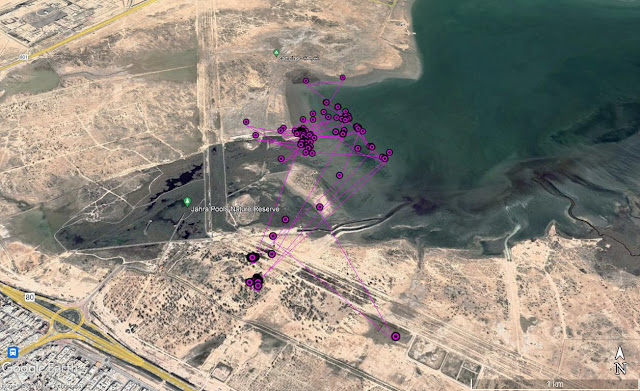
For the most part, the eagles are very settled on Al Jahra, and will remain at the reserve throughout the winter period.  Below are maps of what one of the eagles (6490) has done since being fitted with a transmitter, and what it did on a single day.  6490's behaviour, as illustrated in these maps, is "typical" in that the eagle has stayed almost exclusively within the reserve area (although on one day it did fly in a big loop out over the water). 

 In coming posts we'll show how other eagles have ranged since being tagged in December, so come back when those posts are made.

The movement of a Greater spotted eagle (6490) wintering at Al Jahra during Dec 2021 - Jan 2022. © KFAS/KEL/IAR

The movement of a Greater spotted eagle (6490) wintering at Al Jahra during 3 February 2022. © KFAS/KEL/IAR


Friday, January 28, 2022

Greater spotted eagle eye candy


Transmittered Greater spotted eagle soaring over Al Jahra Pools, January 2022. © A. Al-Zaidan

As described in the last post on 18 January (here), we fitted GPS tracking devices to five Greater spotted eagles at Al Jahra Pools in December 2021.  Those join the other eagles we are tracking since January 2020 (see here and here).  Below is some fantastic drone footage of Greater spotted eagles flying above Al Jahra, shot by Dr. Abdulla Al-Zaidan (Deputy Director General at the Environmental Public Authority).  It is with the permission of the EPA that the study into Greater spotted eagles is being conducted.  (Click twice on the image below and it should open in a new window, and be easier to view) If you look closely, you can see the tracking device on some of the birds (around 28 and 35 seconds in), which are fitted as a backpack.  Enjoy!


Update for 6490

 Continuing the post-spring migration updates for the birds we are tracking.... A Greater spotted eagle at Al Jahra, Kuwait during winter 20...